
I’ve has some non-cancer related stuff going on for a while and it has choked out my ability to write. I think I might be moving past it now, finally.
Thank you for being patient.
I had coffee with a new friend this morning. We spent two hours enmeshed in one of the more memorable getting-to-know-you conversations of my adult life.
I’m not gonna lie. I’m pretty psyched.
“I’m thinking of cutting off my hair and going all short and edgy,” I confessed.
Oh, my, g-d. I’m talking about my hair. She’s going to think I’m self-centered and superficial.
“When we do that, it’s always in reaction to something else,” she said. “What’s really going on?”
Whew.
I thought for a moment. “It’s this conservative morass we’re stuck living in. I just want to make it obvious that when you scratch the surface, I’m a radical.”
My new friend looked at me.
“Really, I am.”
She looked at me.
“All right, I have this old theory, a really old theory that I came up with when I was in my teens. If you really get to know someone who is heavily goth, or punk, or whatever, you find out that they’re quite often just a regular person with the same insecurities and anxieties as everyone else, and the look, goth, or punk, or whatever, is, to a large degree, compensating for just feeling extremely normal. I’ve typically had a very conservative look, compensating in the other direction. And I think I want to move away from that.”
“So you’re telling me that you’re a punk, a part of the counterculture?”
I thought about it. “Not quite punk. It’s more of a strong gothic streak.”
I blog about death.
“Is this new, after your illness? Or have you always been this way?”
I’m stunned.
“Always been this way. I was a goth little kid with a morbid sense of humor, a little Tuesday Adams. In the seventies. In retrospect it was hilarious.”
I think I’ve always known. When I heard the word cancer, I wasn’t surprised. It’s as if the first half of my life was one big opening act for me to live out the second half of it in this semi-undead state of post-life existence.
I’m not a woo-woo kind of person, generally speaking, but I wonder how it is that I’ve always known this about myself, and I wonder what else I could find about myself if only I were open to listening.
On the way home from the hospital after our very first visit, I was reading the “chemo book” out loud to Chris. It was a depressing read except for one line: “For more information, check out our video, “How the Bowel Works,” which I could barely speak out loud for giggling like a nine-year-old.
It became a byword. Whenever we needed to add some levity, one or the other of us would suggest picking up that video from the MD Anderson library and we would snicker.
Today, eight rounds of chemotherapy and seven surgeries later, I still giggle, but I also know that a functioning digestive system is a miracle not to be taken for granted. And I’m thankful, every single time I step into the bathroom.
Happy Thanksgiving. Be sure to eat plenty of fiber.
Chris’s parents are visiting us for the holidays.
His mom is on a restricted diet — no gluten, no dairy, no eggs, no soy, and, worst of all, no chocolate. I can make enough food that we can all eat well for a few weeks. I’m sure I’ll lose weight.
Here’s what I’m thinking about.
How much do we all take for granted, being healthy. Being able to eat cheese, or bread, or (best of all!) cheese melted on bread. Fondue, the cheese kind and the chocolate kind. Of course I am happy to accommodate her dietary restrictions. I remember being intolerant to all kinds of foods when I was on chemotherapy or, worse, pregnant.
The thing that’s killing me is how much she appreciates it. From my point of view, of COURSE I will bend over backwards to meet her food needs. From her point of view, it’s a huge deal.
I think it’s a generational change in how we treat people with differences.
An article by Jane Brody in today’s New York Times hit me right between the eyes.
She says what I say, and what I wish more people would say, which is that cancer treatment often makes no sense at all. If someone is going to die anyway, why put them through hell on the way there?
Why indeed? Because no one wants to die. The article, which is worth a read, talks about the inability of so many cancer patients to admit that they are going to die, sooner.
It’s a hard thing to admit. It’s an even harder thing to know, and I think we put an unfair burden on our doctors to tell us what will happen to us. Because they can’t know.
Here is what they can, and do know: they know the outcomes of other patients with cancers similar to ours and treatment plans like the ones they are proposing for us. In my case, between 60 and 70 percent of women presenting with breast cancer like mine died within a few years. I’m obviously in the minority of women who didn’t, and I have always been grateful to my doctors for being open with me about my prognosis.
“I’m sorry,” my surgeon told me in a moment of complete candor I will treasure forever.
On the other hand, I was open to hearing bad news. I asked, and asked directly.
“How serious is my disease? Is it curable? Are we just going to make my last few months a living hell?”
“I hope not, but your disease is curable,” I was told.
Not everyone has my kind of outlook. I imagine most people wouldn’t want to know.
I think the only thing missing from Ms. Brody’s outstanding article is the concept of grace, and the acknowledgement that everyone is just doing the best they can in a bad situation.
Best post ever.
A physician talks about the pre-abortion sonogram law. “It’s time for a little old fashioned civil disobedience,” he says.
Thank you.
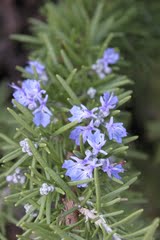
 A friend of mine has a bad case of uterine fibroids and is about to have surgery to fix it. She’s understandably scared, of the surgery itself, of any complications with her possible future fertility, and because the doctors have thrown around the word malignancy, she’s freaking out just a wee little bit. In order to give her a morale boost, our mutual friend Moxie of Ask Moxie fame asked her readers to tell their stories about fibroids and fertility. So far so good: Moxie’s readers never fail to deliver — except for one woman who posted about raw food, herbs, and yadda bullshit yadda. And then, while researching plants for my garden I stumbled upon a link to a web site promising herbal cures for cancer. Oh my! If only I had known! Wormwood! I could have harvested some plants of uncertain potency but poisonous certainty, brewed them in unmeasured quantity, and drunk them — during the dark of the moon, perhaps — and cured my cancer that way. It feels like a sock in the gut.
Healthy food is healthy. Herbs are good — I have a huge herb garden, and that’s why I was googling plant names. Furthermore, research never hurt any one — so what’s the problem? I am reminded of the six stages of learning according to Ibn al-Qayyim:
Firstly: Asking questions in a good manner.
Secondly: Remaining quiet and listening attentively.
Thirdly: Understanding well.
Fourthly: Memorising.
Fifthly: Teaching.
Sixthly – and it is its fruit: Acting upon the knowledge and keeping to its limits.
Call it bad science. Call it an epistemological fallacy. The persistent myth that modern medicine is wrong, that we should address our ills with commonly found garden plants fails on all six counts, and most importantly, the sixth: acting upon the knowledge and most especially keeping to its limits.
There is nothing wrong, per se, with an herbal tincture. What’s wrong is letting superstition stand in the way of science, and preying on gullible people who fear what they do not understand. Spreading the lie garden plants or, worse, proprietary and expensive herbal blends, will cure cancer jeopardizes people who don’t even know the right questions to ask but who will blindly trust someone who tells them what they want them to hear. It insults the tens of thousands of women and men who have devoted their lives to the study of disease and the quest for a cure. It insults the millions of women and men, including me, who have undergone treatment pushing us to the very brink of death so that we might have a chance at life. And most of all, it’s an abhomination of an an insult to the men and women, husbands and wives, sons and daughters, brothers and sisters who have lost their lives to cancer, implying that had they only but opened their minds they might have lived.
I know that people truly believe in the magic power of herbs — and I also acknowledge that plants play a key role in many forms of legitimate religious practice. I know that my lone voice will never change anyone’s mind. And I also know, because my doctors told me so, that a certain number of cancer cases, about 10% according to my doctor, do resolve themselves without any medical intervention.
But conflating the power of herbs with a magic cure for cancer takes us back to the dark ages when a cancer diagnosis was a death warrant.
 Chris and I spent today working in the garden. It’s time to plant stuff, here in Texas. As the shadows grew long, we sat on the front porch and drank beer. Then he said, “How come you care?”
“Huh?”
“How come you care so much?”
“Huh?”
“You’re married. We can afford more kids. You can’t possibly get pregnant — you don’t have any more ovaries. How come you care so much about birth control and abortion rights?”
“Three out of the five guys from my friends list who re-posted my rant on birth control and abortion rights are gay. It’s not about ‘what might happen to me.’ It’s about the fact that when the rights of half the population disappear, everyone suffers. It’s like there’s this huge movement to move us back to the bad old days like things were in the fifties.”
“Everyone says the fifties were great. Even your mom says the fifties were great.”
“My mom says the fifties were great because she was as rich as Croesus, but when you press her, she also says they sucked for everyone who wasn’t a white guy. The feminist movement came out of the fifties. The civil rights movement came out of the fifties. No one wants to go back to the fifties.”
Chris drank a long pull off his beer.
“So, I’m a white guy. Why shouldn’t I want things to go backwards?”
“So our daughter can get raped and then have her entire sexual history put on trial? So that if our son turns out to be gay, he’ll have to live in the closet? So that neither of our kids can ever date — or marry — someone from another race or culture? Like you did? So that we all think it’s okay to round up an entire nationality and imprison them for years?” At this point I was starting to get all hot under the collar, but Chris was grinning at me.
“Well, I’m a white guy. Things for me would be pretty great, wouldn’t they? So why should I care?”
“So what you’re saying is that the people who talk so much about returning to the social values of an earlier era are pretty much assholes?”
“Pretty much. Now, woman, I spent all day working in the garden for you. Go make me a sammich.”
“Make your own damn sammich. I’ll bring you another beer, though.”
“Make sure you take your shoes off when you’re in the kitchen.”
That’s how it is, huh.”
“Damn straight.”
“Sexksay.”
Then Chris finished his beer and went to build Legos with our kids.
Thanks, everyone, for the huge response to the post I wrote earlier.
 Well, no, it’s not, but it’s not good, either.
Housekeeping is not a strong point with me. Instead of being the superwoman I am in my imagination, I spend hours standing in my slightly messy house wondering what to do next. What to do first. Where to begin. I’m at a stage where everything is functional, but there are small piles of clutter scattered about the house. I know to conquer them one pile at a time, but I’m overwhelmed — or else underwhelmed, because there are always things I would rather do, like cook, or write, or go for a walk, or take a nap.
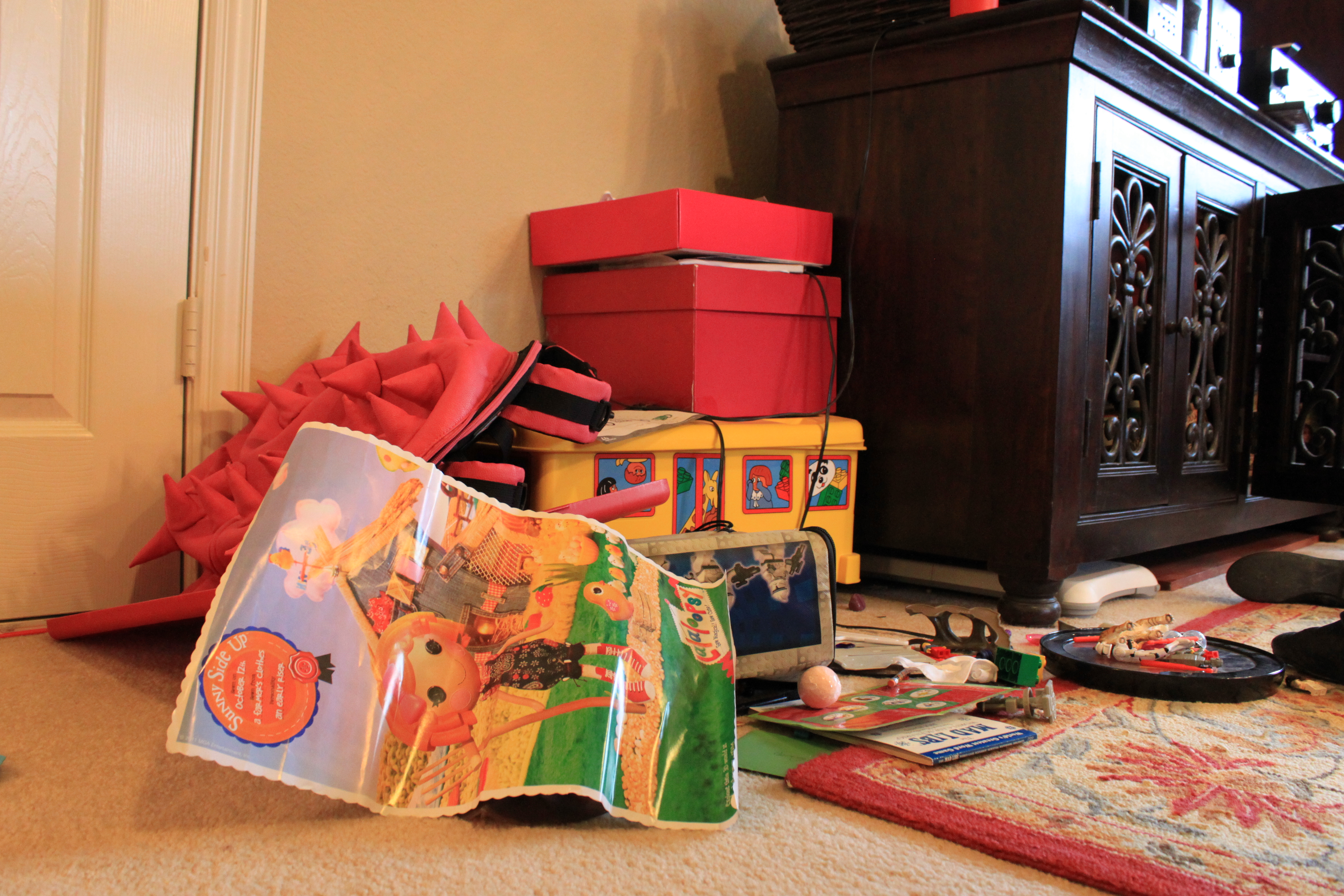
I just went and took a picture of a pile of toys upstairs that’s been there for a few days (weeks). Chris said, “So you do see the mess.” I do, but I don’t know where to begin to deal with it. So I’m doing what I know to do, and that is to write about it.
It’s a start.
 “I don’t want to plant plants in the rain,” Chris said this morning. I couldn’t hear the raindrops plonking on the patio outside our bedroom, but he could. Chris has what they call hyperacute hearing. Our back deck is full of plants in pots, as well as a couple of bare-rooted rose bushes, that all need to be stuck into the ground in various places around our back garden. We have half a pallet of concrete retaining-wall bricks in the front yard that need to be moved to the back yard. Our generous neighbors have three wheelbarrows of paving bricks they need us to move from their side yard to our side yard — leftovers from a job we almost finished last weekend. And now it’s raining.
In preparation for a day of garden work, I have a fridge full of good food that only needs to be heated up and eaten. The house is tidy, and the kids have promised to keep it tidy — a promise I know they’ll keep because we gave them the new Harry Potter Lego Wii game. I think video games are a great fun way to teach the kids to play together — and it keeps the house tidy, so I’m a fan.
I did laundry yesterday.
Catherine made breakfast, all by herself.
I do have a couple of errands to run, but mostly, I have the gift of a day at home with not a whole heck of a lot on my to-do list.
It’s a surreal feeling. Did I slip into an alternate universe in which I never had cancer at all? Is this normal life?
 Dance with the Reaper